Overview
I’m only now getting around to writing up a few reports from my recent birding travels in Southeast Asia (Singapore, Malaysia, and Thailand). This first article focuses on Singapore and Malaysia, covering practical logistics, birding information, and other useful tips for visiting birders. Over 23 days, Robbie Millar, Aadam Abdullah, and I, self-drove and self-guided our way across this incredibly biodiverse region, covering most of the key birding sites in Singapore and Peninsular Malaysia and recording a total of 361 species. Our primary objective was to see all accessible Peninsular Malaysian endemics, as well as a selection of species best targeted in this region. We achieved the first objective and were largely successful in the second.
In preparation for the trip, we spent months scouring eBird for information on our target species and consulted a variety of trip reports, most of which were sourced from CloudBirders. We relied primarily on the Merlin Malaysia Pack as our field guide, occasionally supplementing it with the Lynx and BirdLife International Birds of Thailand field guide, which covers most species occurring in Peninsular Malaysia.
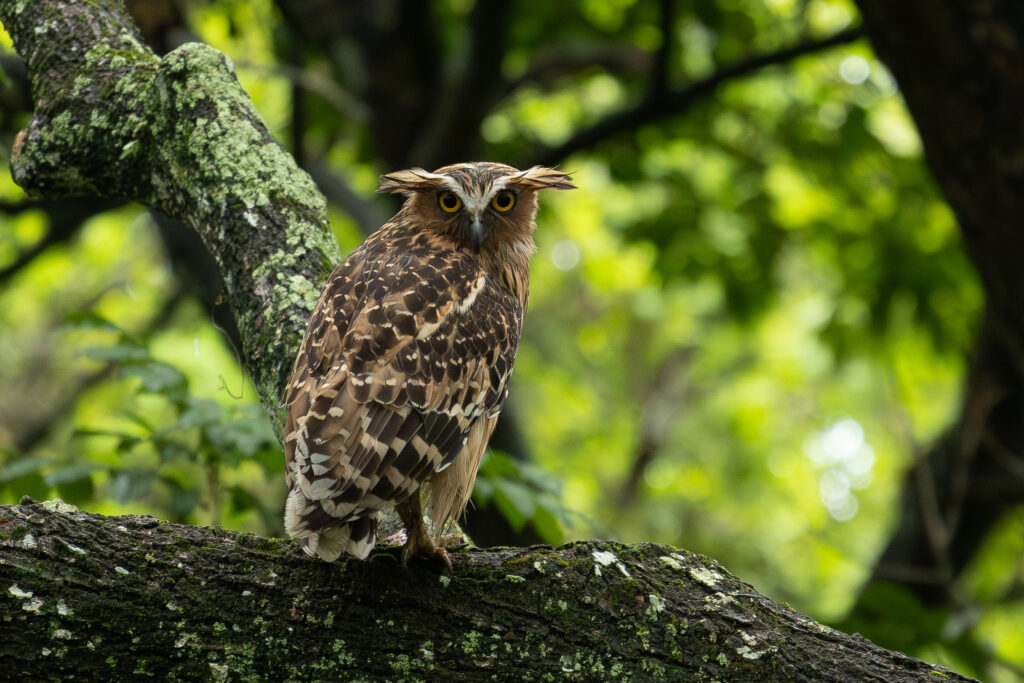
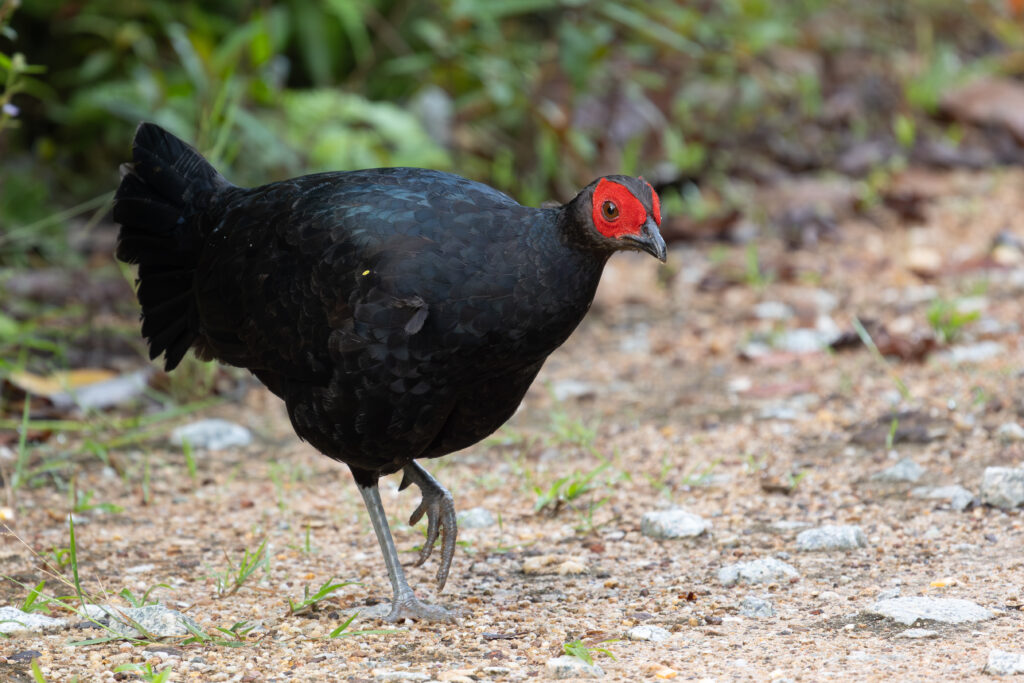
Some of the real stand-out species that we saw included the likes of Crested, Malayan, and Chestnut-necklaced Partridges, Malayan Crestless and Malayan Crested Firebacks, Great Argus, Malayan and Mountain Peacock-Pheasants, Cinnamon-headed Green Pigeon, Gould’s Frogmouth, Red-legged Crake, Chinese Egret, Malaysian and White-faced Plovers, Von Schrenck’s Bittern, Dusky and Barred Eagle-Owls, Rhinoceros Hornbill, Garnet Pitta, Rail-babbler, Crested Jayshrike, Straw-headed Bulbul, Malayan Laughingthrush, Grey-breasted Babbler, Rufous-vented Niltava, and Malayan Whistling Thrush.
Balanced against these successes were a few notable dips, which included Helmeted and Bushy-crested Hornbills, Jambu Fruit Dove, Malaysian Blue-banded Kingfisher, Dusky Broadbill, Malaysian Hawk-Cuckoo, Malaysian Honeyguide, Greater Green Leafbird, Red-bearded Bee-eater, Malaysian Blue and Rufous-chested Flycatchers, Rufous-tailed Shama, Cinnamon-rumped, Diard’s, and Red-naped Trogons, Slaty-backed, White-crowned and Chestnut-naped Forktails, Grey-cheeked Bulbul, and Temminck’s Sunbird. These misses were due to a range of factors, but most often came down to having too many target species at each site and not enough time. Such is the nature of forest birding, especially on a first visit to Southeast Asia, where everything is new.
The following notation will be used across this trip report: Heard-only species will be italicised. All species seen are in bold, and species mentioned but not seen are in normal font.
Our eBird trip report is available at this link: https://ebird.org/tripreport/436489.
Route
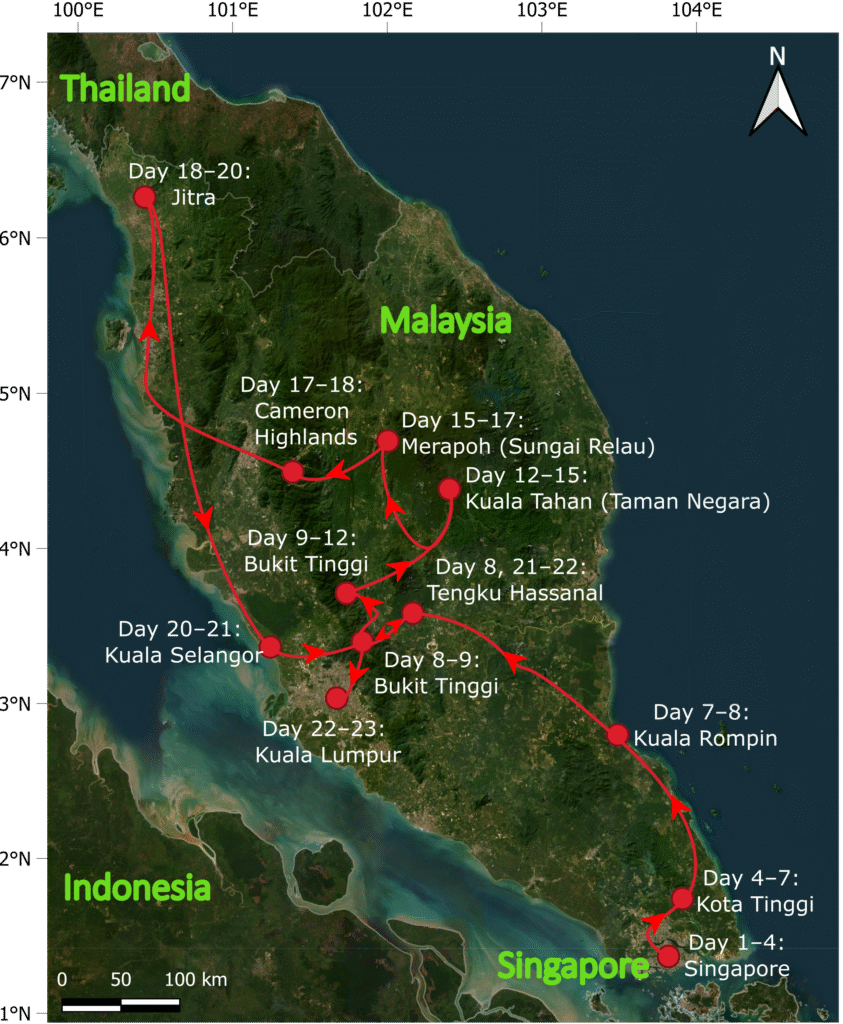
Our trip started in Singapore, where we spent the first three days visiting several sites around the city-state. We then crossed the border into Malaysia at Woodlands Checkpoint and collected our rental car in Johor Bahru. From there, we travelled to Kota Tinggi, using it as a base to bird at Gunung Panti Recreational Forest. After Panti, we spent a night in the coastal town of Kuala Rompin before heading west towards the highlands. Here, we visited the Japanese Garden in Bukit Tinggi, followed by the legendary Fraser’s Hill.
Next was Taman Negara National Park, where we stayed in both Kuala Tahan and Merapoh to access different sections of the park. We then continued northeast to Kedah and the small town of Jitra, with a night in the Cameron Highlands en route. Following our time in Kedah, we spent a night in Kuala Selangor and visited the Tengku Hassanal Wildlife Reserve before concluding the trip in Kuala Lumpur.
Cost
As we were all on student budgets, keeping costs as low as possible was a priority. All costs are listed in US dollars. Our initial plan was to camp as much as possible; however, the constant risk of rain (nothing is worse than packing wet tents) and the general lack of campsites at many of the locations we visited made this impractical, unlike in Thailand, where camping is widely available. In the end, we camped for just a single night at the Japanese Gardens (and yes, it rained!).
Instead, we opted for cheap hotels, hostels, and private listings on Booking.com, which did increase accommodation costs. Our total accommodation cost came to $425 per person for the entire trip, of which our three nights in Singapore alone accounted for $111. This was still considerably less than we had budgeted for, and we were pleasantly surprised by the overall standard, often basic but generally very comfortable. Aside from our three nights in Singapore, we did not book accommodation in advance, typically arranging places to stay via Booking.com or Google Maps while having lunch on the day.
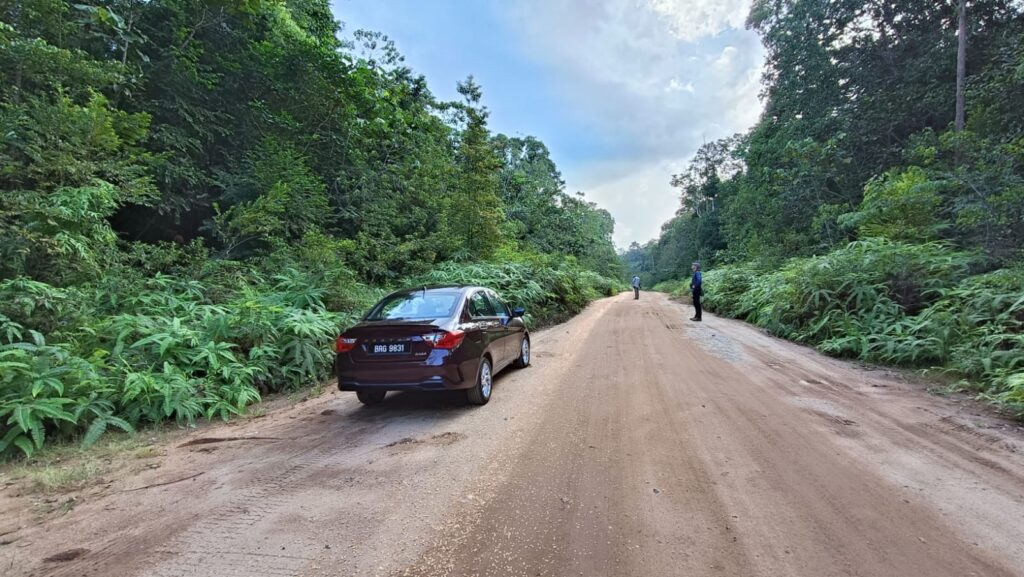
We hired a car from SIXT, collecting it in Johor Bahru and dropping it off in Kuala Lumpur. We selected the second-cheapest option, a Proton Saga (compact sedan), which worked well for the three of us. From a birding perspective, there is no need for a high-clearance or four-wheel-drive vehicle in Malaysia, as all the main birding sites are accessible via good roads, even during the peak monsoon season when we travelled. The car rental cost $280 per person in total. Fuel is relatively inexpensive in Malaysia, and we spent just $56 per person on fuel for the entire trip.
There are tolls on some of the main highways, and we each spent about $7 on these. Not all toll booths accept card payments, so it is worth carrying some cash. There is also a “Touch ’n Go” card system, which can be topped up easily at service stations, but we found it simpler to pay cash.
In Singapore, we used the excellent public transport network to access the main birding sites, spending $27 per person. Food and drinks were inexpensive overall, and we mostly ate at local restaurants and made frequent stops at ZUS Coffee outlets. Our total food and drink expenditure came to roughly $260 per person.
Additional incidental costs included entrance fees, two occasions where we hired a local guide, a SIM card, and parking. I did not track these closely, but they came to approximately $115 per person.
Overall, the total cost of the trip, excluding flights, was approximately $1,170 per person.
Season and Weather
Due to our various work and university schedules, we had no choice but to do this trip in December. After speaking with other birders, reading trip reports, and reviewing eBird data, it became clear that December is one of the least favourable times for birding in Peninsular Malaysia. We were even advised that the season should be avoided entirely, and received messages such as “Good luck, it will rain all the time.” December falls in the middle of the Northeast Monsoon, which typically brings very high rainfall to the region. In fact, just before our arrival, the northwestern states experienced record flooding.
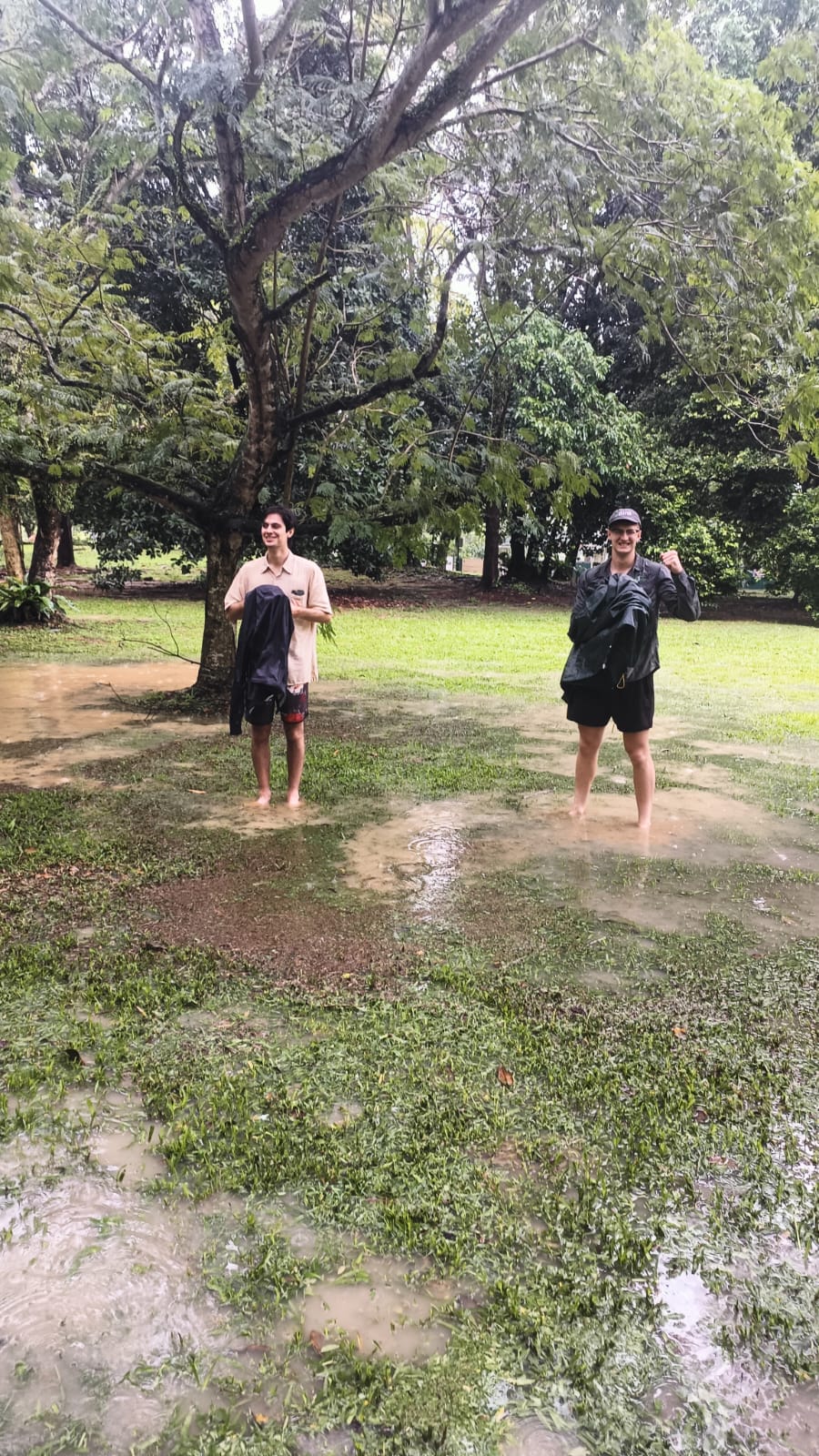
Despite this, rain only occasionally affected our birding plans. In total, there was only one day when the weather significantly disrupted birding, and even then, we went out, persevered, and managed to find our target species in the rain. Whether we were simply lucky or the warnings about birding Malaysia in December are somewhat overstated, I can’t say.
Aside from the rain, we found that birds were generally quiet and often unresponsive to playback. I suspect this was seasonal, and Taman Negara in particular proved very challenging. We would often walk for long periods without seeing or hearing much activity, and most playback attempts were met with silence; more on that in the detailed report. This was less pronounced at higher-elevation sites such as Fraser’s Hill and the Cameron Highlands.
Lowland sites such as Gunung Panti Recreational Forest and Taman Negara were hot and humid as expected, while highland sites were significantly cooler and even chilly in the evenings. We found that the first few hours after sunrise were consistently the most productive, while afternoons and evenings were generally much quieter.
Driving
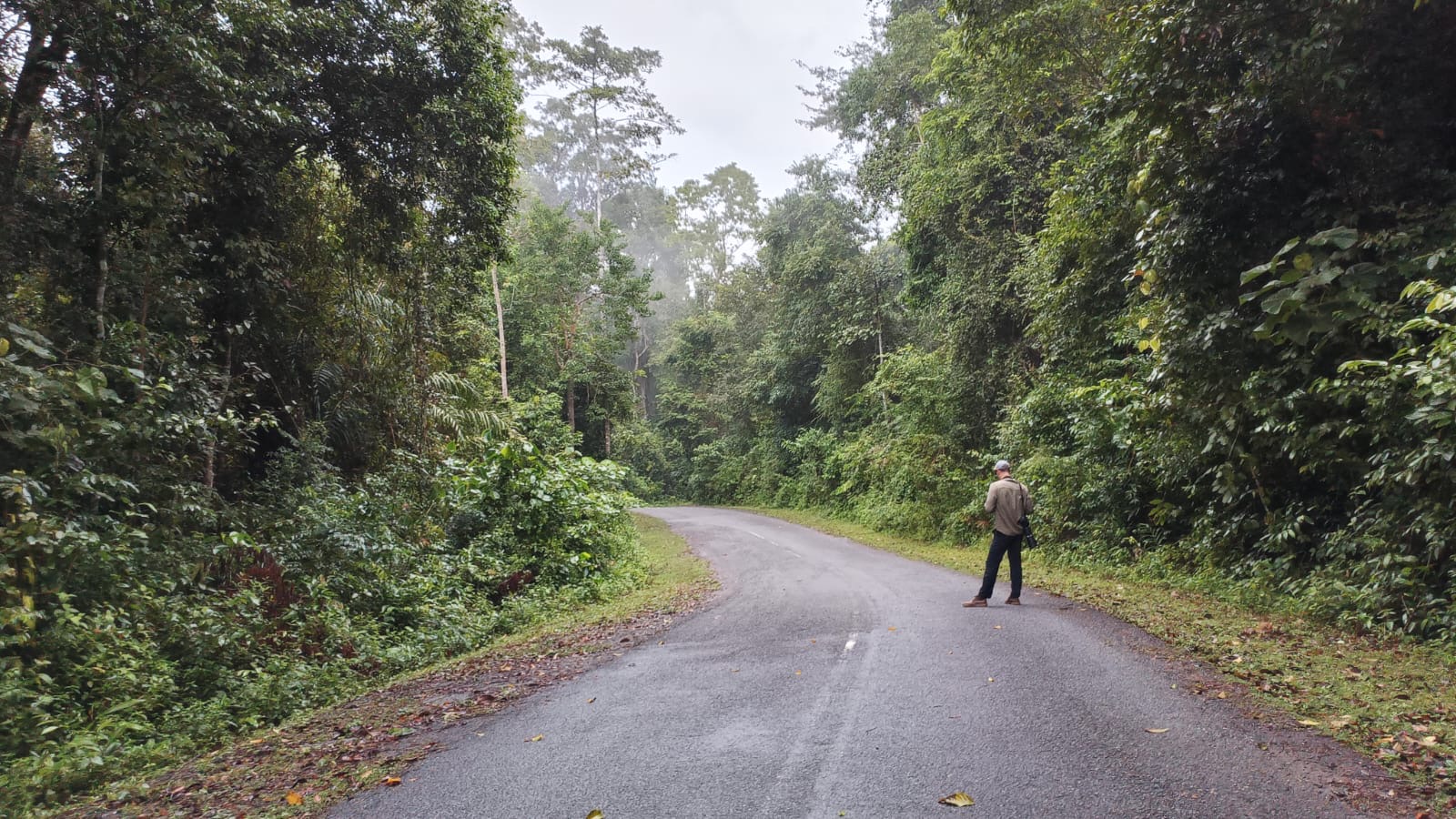
Overall, we found driving in Malaysia straightforward. The main roads were in good condition, and despite some of the towns being quite busy, drivers were generally relaxed, and one simply needed to follow the flow of traffic. There is no reason to approach driving in Malaysia with any apprehension.
Insects and other annoyances
We had our fair share of biting insects in Peninsular Malaysia. Leeches were abundant at almost all sites we visited, especially at Taman Negara. None of us had leech socks, but we found that by tucking our trousers into our socks and wearing two pairs, we could generally avoid being bitten. Nonetheless, both Aadam and I left Malaysia having donated a fair amount of blood to leeches, while Robbie managed to escape with only a single bite. It may seem obvious, but leaving the trails at Taman Negara, or even stepping off the boardwalk for a few seconds, almost guarantees an unwanted leech encounter.
Mosquitoes were also widespread throughout the trip, except at some higher-elevation sites. In lowland forest areas, it is essential to apply insect repellent thoroughly, and by far the worst site for mosquitoes was Kuala Selangor, where they occurred in plague-like numbers and repellent was largely ineffective.
Ticks were present in some of the grassier areas, but they were less of an issue than in Thailand.
There’s plenty more to come! The next posts will feature a detailed Singapore and Malaysia trip report!